Slow Orbit Above a Long Living Room Sideboard
The picture does not always have to occupy the middle of the furniture beneath it. Slow Orbit 01 sits above one end of a long sideboard in this living-room concept, leaving a broader interval of wall to the other side. The arrangement relies on balance across the whole scene rather than a single centered stack. A low bowl supplies a modest counterweight, and the artwork’s own pale field keeps the larger frame from feeling dense. It is a useful alternative when a long cabinet makes every modest portrait print look stranded at its midpoint.
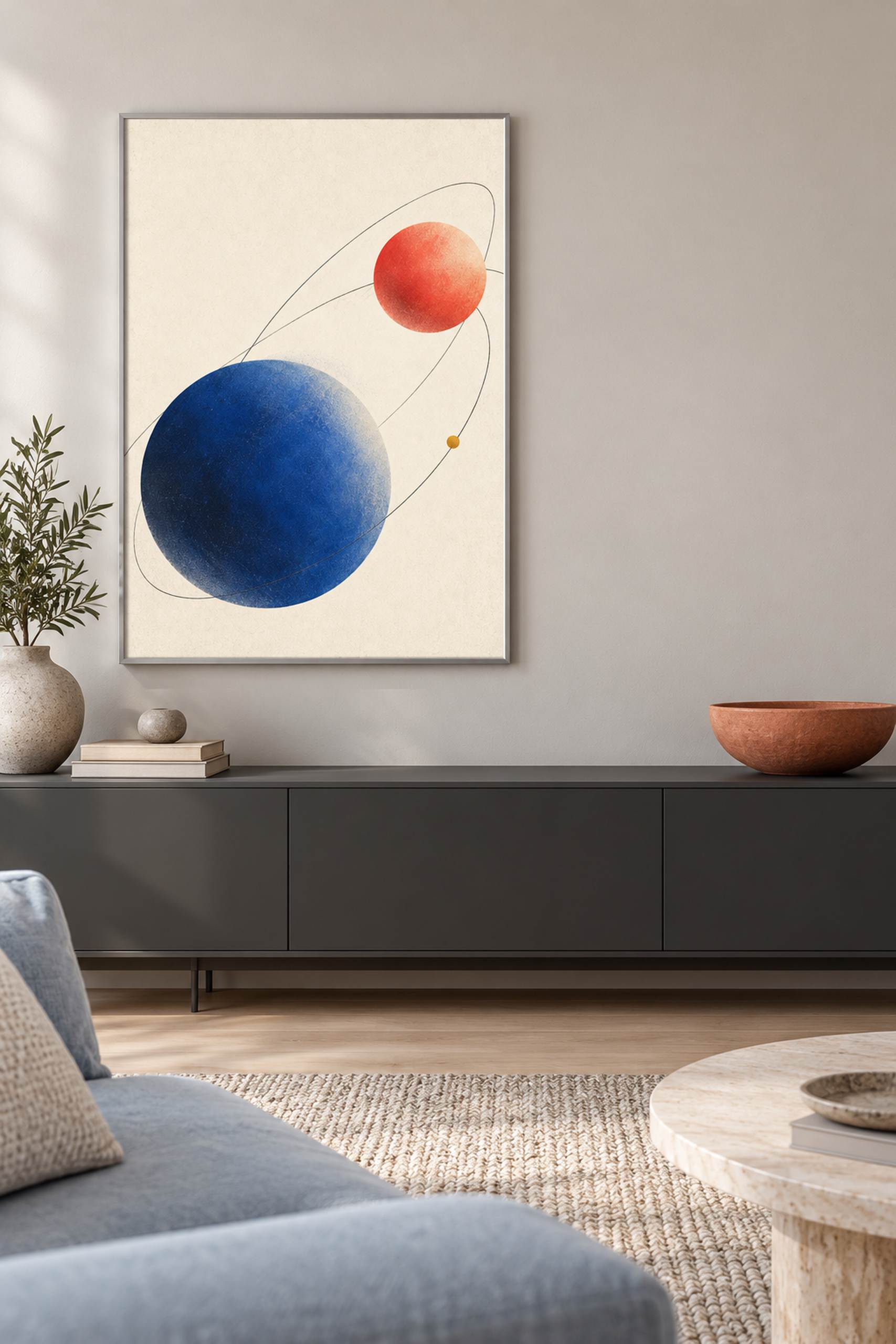
The concept uses a dark, low sideboard against a light warm-grey wall. The orbital poster hangs toward the left, with its slim metal frame picking up the quieter hard edges in the room. A terracotta bowl sits well away from it at the other end, and part of a pale blue sofa enters the foreground. Inside the picture, the large blue disk and smaller coral form give the wall two very different areas of color. The thin paths curve between them, while the pale upper area remains substantially open. Neither the print nor the cabinet is filled simply because space is available.
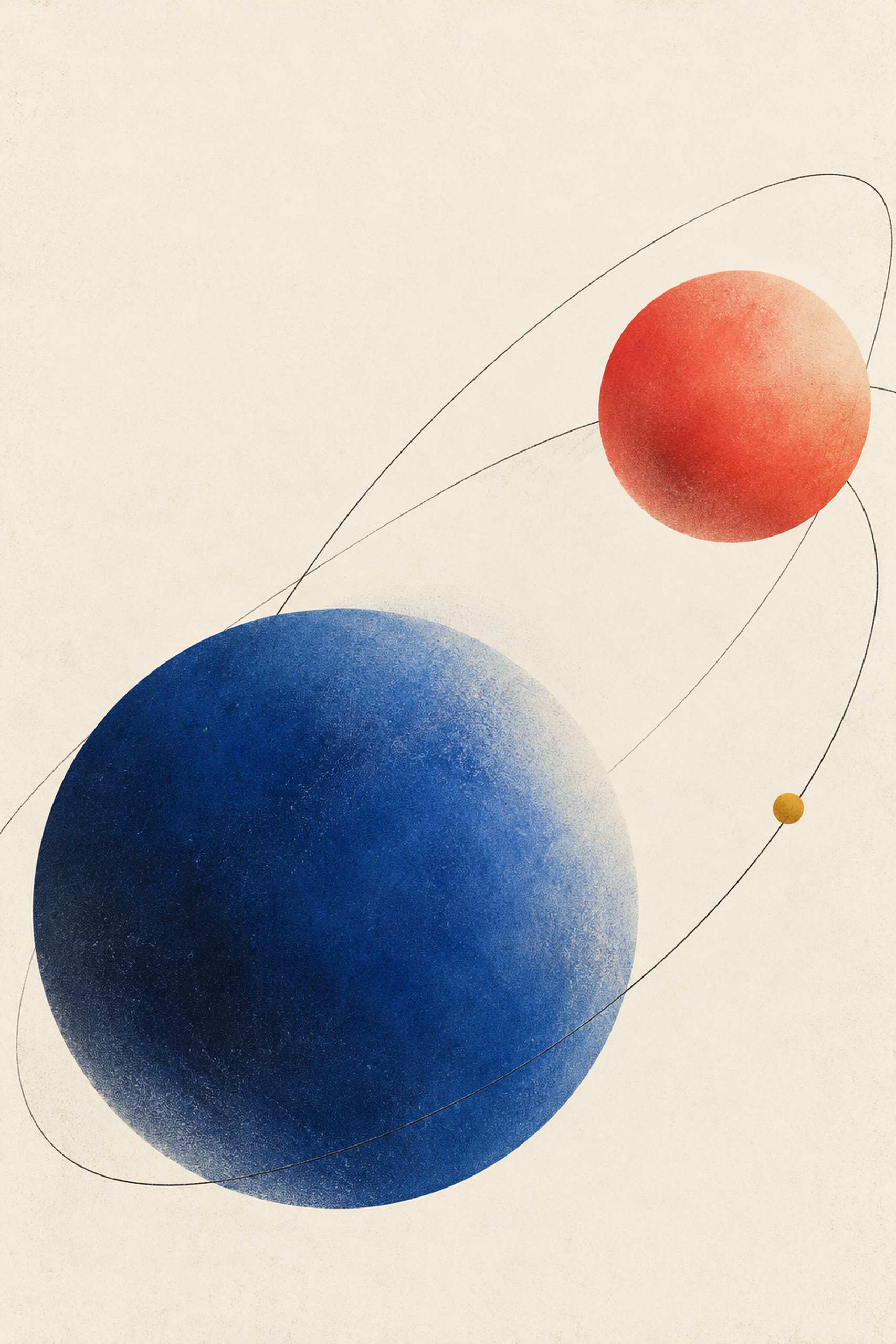
This is the same Slow Orbit 01 shown beside a small office desk. There, the picture participates in a compact working arrangement. Above the longer sideboard, its outside dimensions and position have a different relationship to the furniture. The pale field is especially useful because the frame can have presence without introducing a solid dark block across its whole footprint. The orbital forms are invented graphic elements rather than an astronomical diagram. Their importance here is compositional: a large cool circle, a smaller warm one and lines that give the empty field a direction.
The off-center position should be a considered relationship, not the result of finding the first available hook. Look at the sideboard, the nearest doorway, the sofa and the ordinary route through the room together. A frame above the left portion of the cabinet may relate to the seating more clearly than one centered on the cabinet alone. In another room the right side may be stronger, or a centered arrangement may simply work better. The illustrated position demonstrates one possibility. It does not turn asymmetry into a rule that should be imposed regardless of the furniture already present.
For a worked example, consider an image area of 50 by 75 centimeters above a sideboard roughly 180 centimeters long. The frame adds to the image dimensions, and those outside measurements are what should be tested on the wall. This is a proposed sizing exercise, not a set of dimensions taken from the generated scene. Mark out the full footprint with a paper template, then look from the usual seat and from the entrance. A smaller print could feel more intimate; a larger one could give the pale field more authority. The cabinet’s length alone does not decide which interpretation is best.
The bowl at the far end is deliberately low, so it does not become a second vertical composition competing with the frame. It need not match the coral disk exactly. A warmer ceramic surface offers enough of a relationship, while a bright red lamp or tall sculptural vase would create a much stronger competing shape. If the sideboard already holds several useful objects, work with their real heights and positions before adding another. The arrangement should survive the ordinary contents of the room. A picture that only works after every remote control and book has been removed is asking for rather special treatment.
The room view is AI-generated, and the flat poster preview remains the reference for the artwork. Printed color, paper and glazing need their own physical checks; the scene is not a print proof or a measured installation. I would preserve the full portrait composition, particularly its open upper area, instead of cropping it to make the picture seem wider above the cabinet. The interval around the disks is what gives the work its character. The wall outside the frame can have an interval of its own. A long sideboard does not require an equally long parade of objects to make it feel finished.