Quiet Signals Gives a Stair Landing a Wide Open Desert Horizon
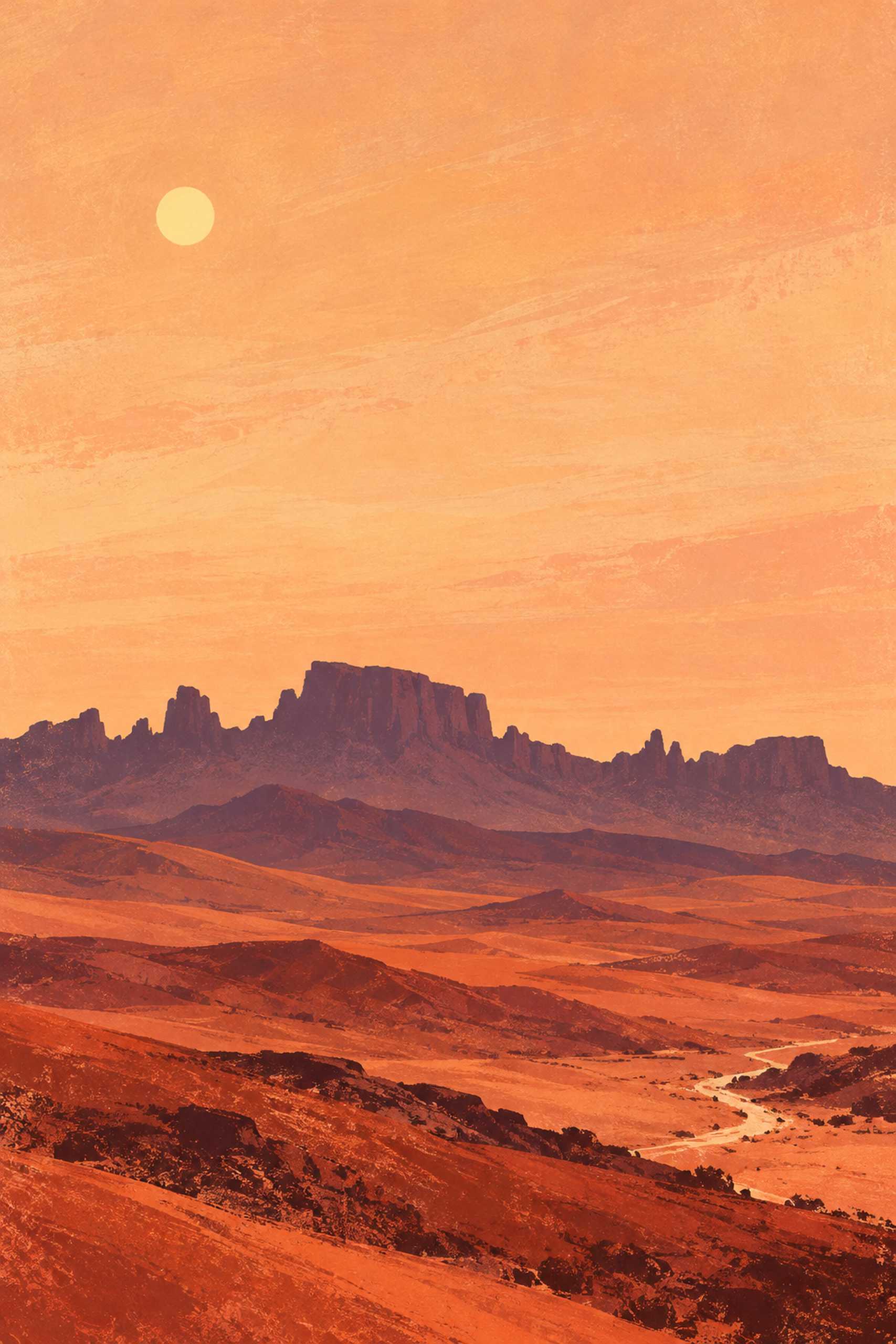
A stair landing is usually a place you pass through, which is precisely why one clear image can have a strong effect there. You meet it repeatedly, from different heights and at different distances. Quiet Signals 02 gives that brief encounter a desert horizon: layered warm ground, a dark distant ridge and a large pale sky. The landscape is invented. Its job is to open a visual distance on a wall where there is no actual window, without requiring the landing to become another furnished room.
The house concept keeps the landing simple. Oak steps, a dark metal balustrade and a pale plaster wall form most of the setting. The framed landscape occupies the flat wall beyond the stair run, visible from the open standing area. There is no console table, floor vase or plant placed in the circulation route. Natural light reaches the wall from above, revealing the plaster’s texture while leaving the artwork legible. Within the image, the sky takes up a generous area above the lower bands of desert color. The darker ridge provides a distant boundary, and the lighter winding mark near the foreground invites the eye to move into the composition.
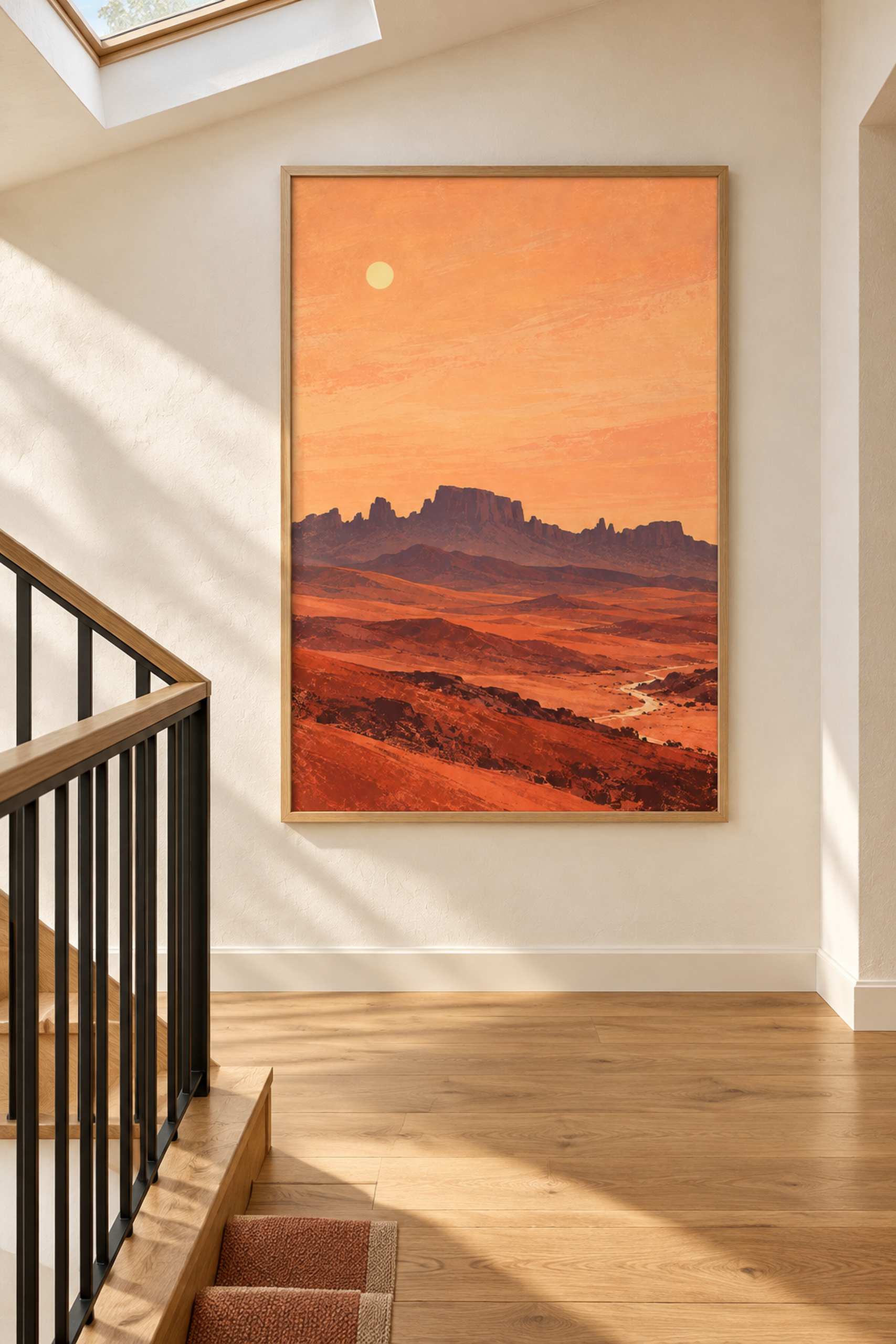
This landscape is about atmosphere and arrangement rather than a named destination. It is not presented as a photograph of a real desert, a travel poster for a particular national park or an illustration of local geology. The palette carries the scene: apricot light, coral and burnt earth, with a quieter purple-brown distance. Their differences establish depth without a mass of small details. In the flat preview, the edge of the ridge and the shifts between warm layers are more important than any single mark that could be read as a rock or path. That lets the work remain a coherent picture during a short glance from the stairs.
Quiet Signals began with a split circle, dark bar and red dot in a reading corner. The second work keeps the interest in large intervals and controlled color, but gives it a landscape vocabulary. A horizon can organize a composition as decisively as a geometric bar, while the open sky performs a different version of the earlier poster’s generous cream field. The relationship between the works is useful without making them a matched pair. A collection should be allowed to develop a recognizable sensibility without repeating the same circle indefinitely.
The pale wood frame relates to the stairs, though matching the wood exactly is unnecessary. A narrow black frame would connect more strongly to the balustrade and give the print a firmer outline against the wall. I would choose between those two relationships before considering a new accent color. The landscape already contains enough warmth. A terracotta object elsewhere in the house might echo it, but the landing itself does not need an accessory to explain why the picture is there. On a route used many times a day, a little visual clarity is usually more useful than an increasingly elaborate arrangement.
For a sizing exercise, try a paper template representing a 40 by 60 centimeter image area plus the actual frame dimensions. View it from the landing and from the normal approach below, while standing safely rather than leaning over the stair edge to find an ideal angle. These are proposed measurements, not dimensions obtained from the generated illustration. Keep the frame clear of the handrail’s use, normal carrying routes and any door swing. The illustration is an AI-generated room concept, not an assessment of a particular staircase or a measured installation plan. The picture follows the available safe wall area; it does not get to negotiate away useful circulation space.
Changing light can make this kind of image interesting over a day, but the digital scene does not predict printed color under your own skylight or lamp. Look at a sample and the proposed glazing from the main viewing positions before ordering a final physical version. I would preserve the whole portrait composition rather than crop a slice of sky to force it into a convenient frame. That open upper area is where much of its distance comes from. A landing may offer only a few seconds of attention at a time. A broad, unhurried horizon is a good thing to find in those seconds.