After Hours Finds a Korean Moon Jar Silhouette for a Bedroom Wall
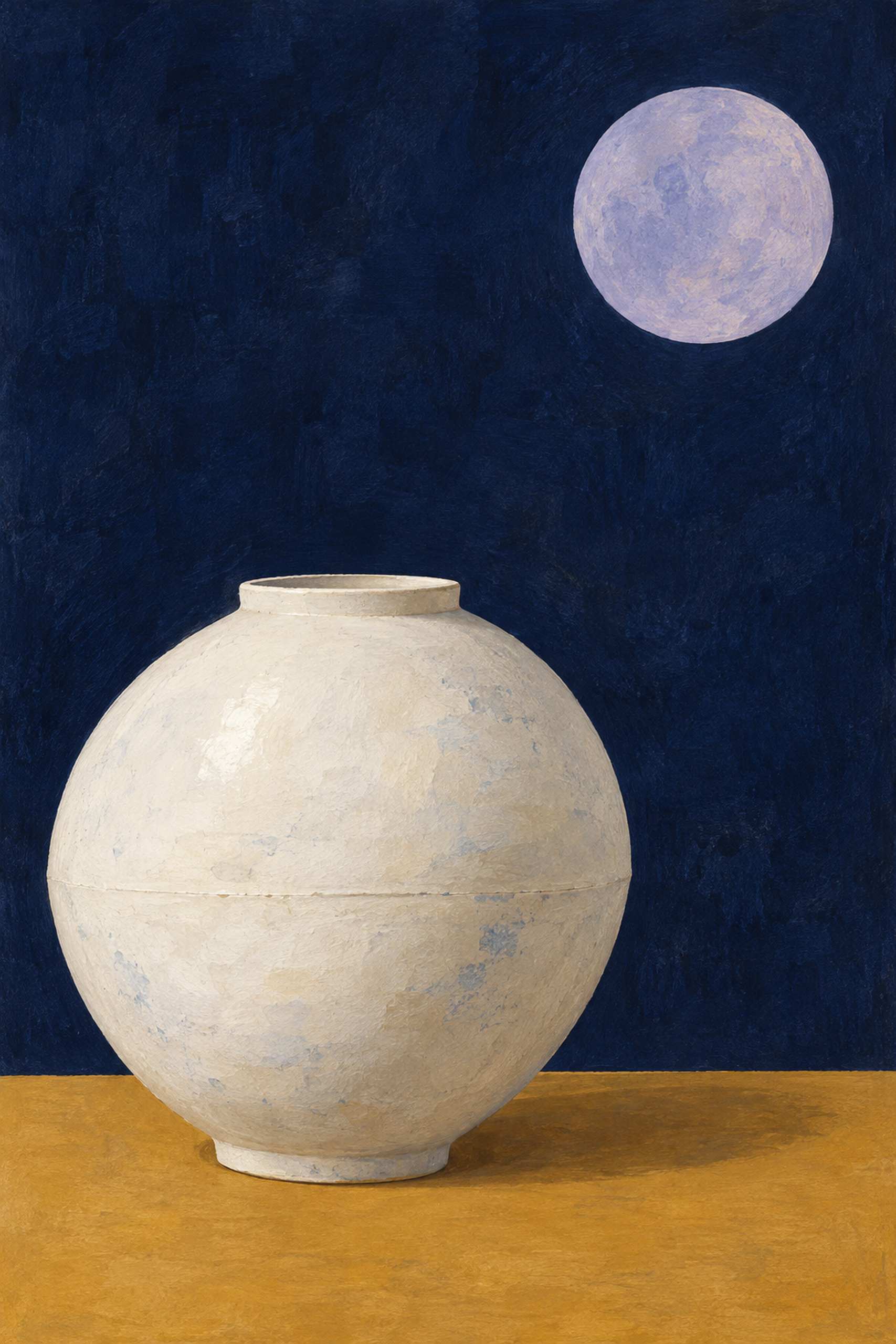
White is rarely one simple color in a painting. Against midnight blue it can turn chalky, luminous, cool at one edge and warm at another. After Hours 02 uses that range in a painted moon-jar form, broad and slightly irregular, set against an indigo ground. A pale circular shape and an ochre surface give the still life a quiet setting. The result feels suited to a bedroom because it offers something substantial to look at without filling the wall with incident. There is a vessel, a shadow and a little room for the eye to wander.
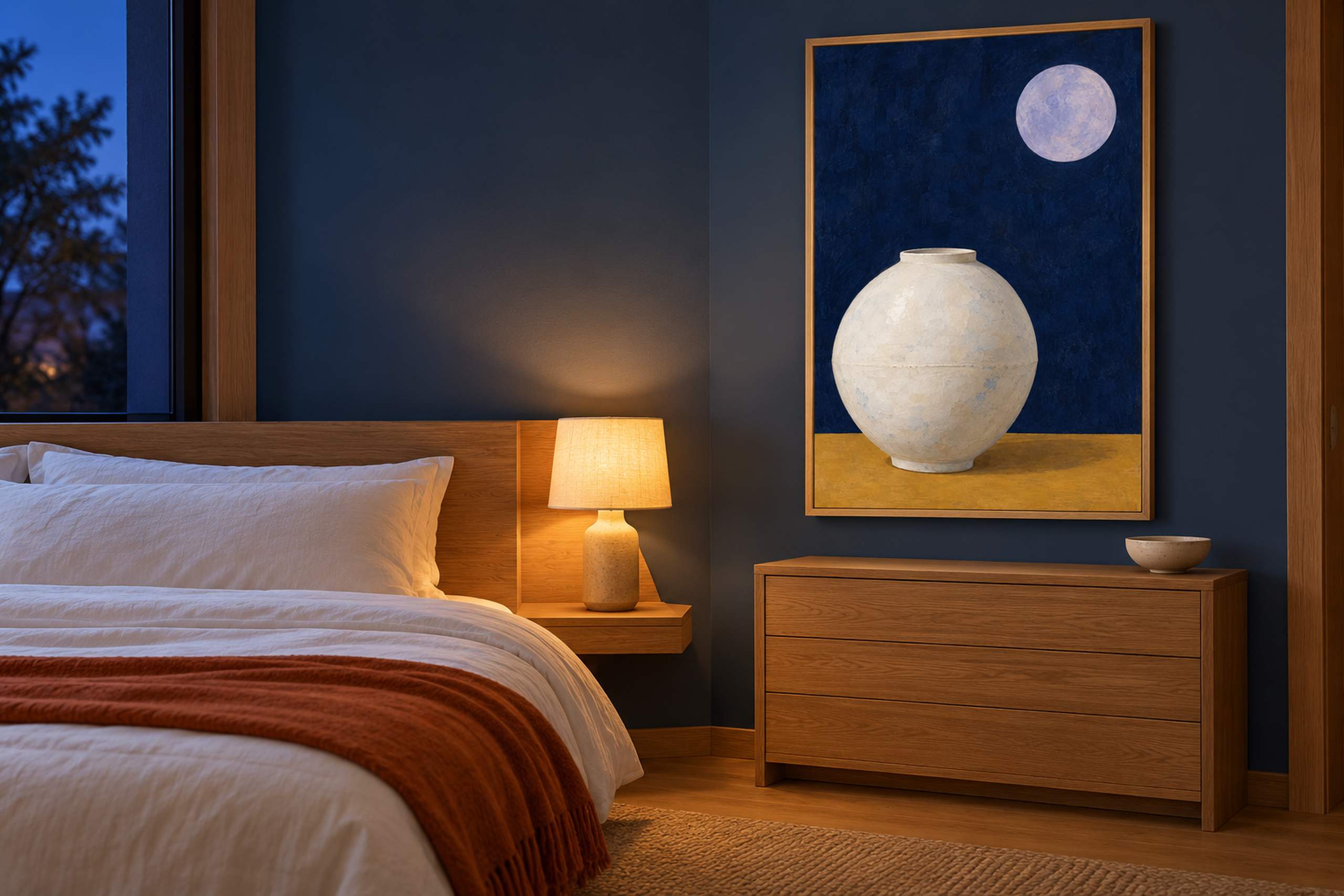
In the room concept, a low oak bed, white bedding and a small warm lamp establish the main materials. The poster belongs to the adjacent wall above a compact dresser, where it can be seen from the bed without competing with the pillows or bedside surface. Blue tones around the artwork relate to its dark ground, while the oak frame connects it with the furniture. An orange textile gives the room a warmer interval. The picture’s jar carries most of the light within the composition. Its rounded body is interrupted by subtle changes in painted tone, rather than by a decorative pattern placed on the surface.
The moon jar is a specific Korean ceramic reference, not a generic label for any round vase. Historical examples are associated with white porcelain, generous rounded bodies and the joining of separately formed upper and lower sections. Slight irregularities can remain visible in their profiles. The poster interprets that form as a contemporary painted still life; it does not reproduce a named museum object or claim to show a real ceramic piece for sale. The vessel’s small neck and modest foot matter to the silhouette. A perfectly drawn circle with a handle would be a very different subject.
Look closely at the flat preview and the white body becomes less like a blank disk. Blue-grey marks suggest volume, and the boundary between the jar and the dark field is not equally sharp everywhere. Those quieter variations reward a closer view, while the main silhouette remains legible from the doorway. The separate pale circle introduces a second kind of roundness, simpler and flatter. It makes the jar’s irregular body more noticeable. The ochre plane below provides enough support to keep the vessel from floating, which is a useful difference from the deliberately impossible fruit in Kitchen Mischief 02.
This is a change of pace within After Hours. The first poster uses pink, red and coral shapes in an evening listening corner. The second allows a light vessel to occupy a dark field more quietly. They share an interest in how a large simple form reads under softer room lighting, but they do not need identical furniture around them. In a bedroom with pale walls, the new print would be a clear dark rectangle; against a deeper blue wall, its edges would feel less emphatic. Neither approach requires painting the entire room to match the image.
For a practical size test, use a 40 by 60 centimeter image area and include the actual frame’s outside measurements. Try a paper template above the dresser, then sit or lie in the position from which you expect to see it. A frame can look well placed when you stand beside the bed and oddly high once you are in it. These are proposed dimensions rather than measurements of the generated room. Keep the dresser’s top usable and allow for objects that genuinely live there, including a lamp if yours is taller than the illustrated one. A poster should not require permanent removal of the things you reach for every evening.
The room image is an AI-generated concept, so the warm lamp and blue-hour light are illustrative, not a color proof for a printed edition. Before choosing a physical print, inspect a sample under the bedroom’s actual lighting and look for reflections from the intended viewing position. A slim oak frame offers a warm boundary; black would make the image more independent of the dresser. I would begin with the quieter material connection and let the painted white do the rest. There is already enough character in a round form that declines to be perfectly round.